TL Insights
Back to TL Insights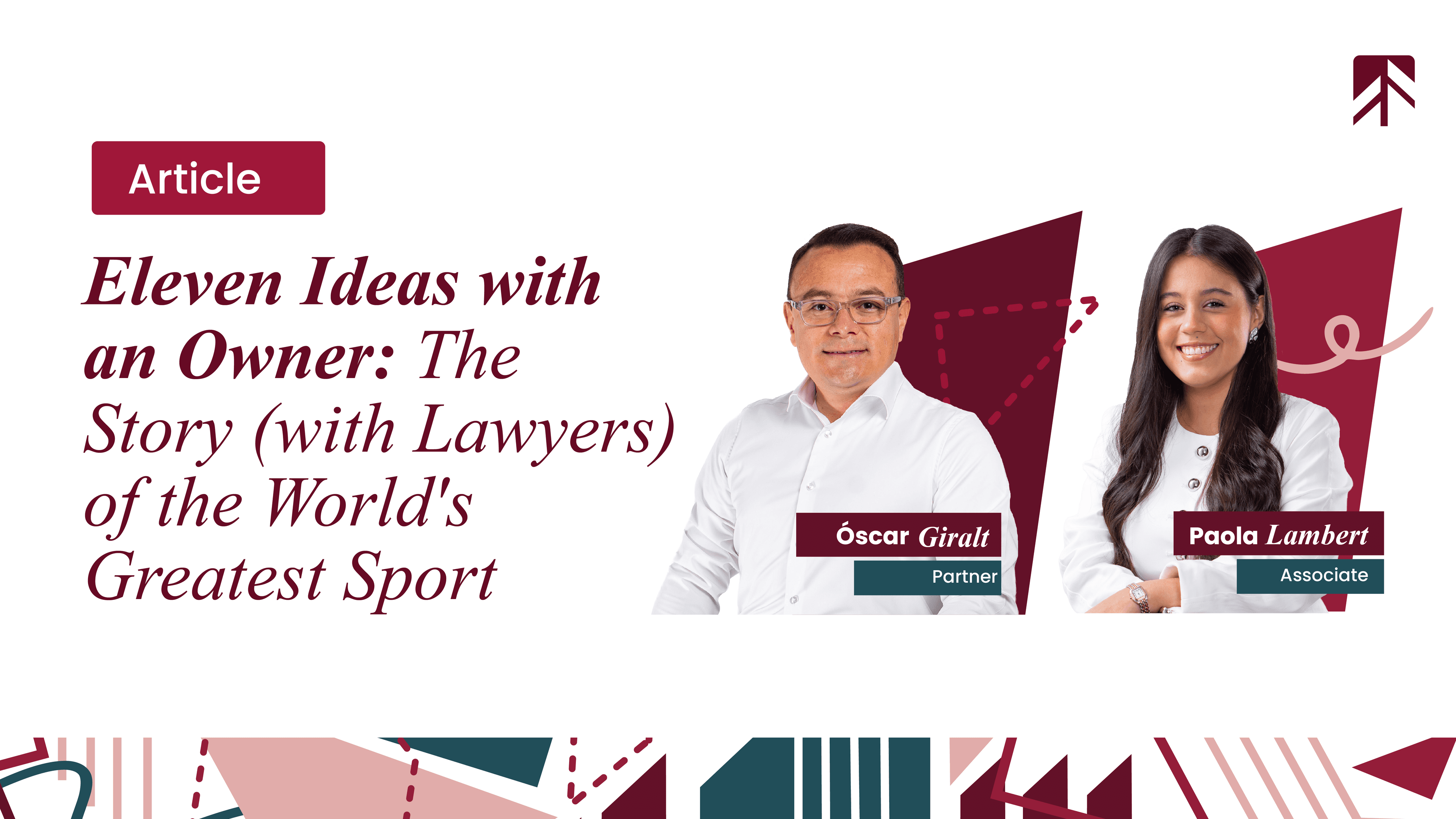
Eleven ideas with an owner: the (with lawyers) history of the world's biggest sport


This article was born at the precise moment when the fever for the biggest sporting event in the world began to take over everyone this year. It was born from a conversation between someone who loves soccer from the memory of their grandfather, a physical education teacher, and someone who loves intellectual property because they deeply believe that ideas also deserve history, care, and ownership. Coco sees soccer as one who recognizes a family heritage. I see it from another place, perhaps less evident but just as exciting: from the brands, patents, contracts, image rights, and all those invisible creations that make the world's greatest sport also one of the most powerful industries on the planet.
But before this event ended, we decided to write this article: not only to talk about the World Cup that everyone sees but to show that behind the sports spectacle there are ideas, rights, and decisions that explain why soccer ends up being worth millions.

Each World Cup is played twice. One is the one the whole planet watches: ninety minutes, a ball, eleven against eleven. The other is played far from the grass, without a visible referee, among records, in sponsorship contracts, licenses, image rights, and increasingly in courts. That second field has been played long before FIFA itself existed, and this is its starting lineup: eleven real and verifiable stories that show that in soccer, nothing happens by accident. Everything has, or ends up having, an owner.
Let's start with the goal.
The doubtful goal that ended in a patent
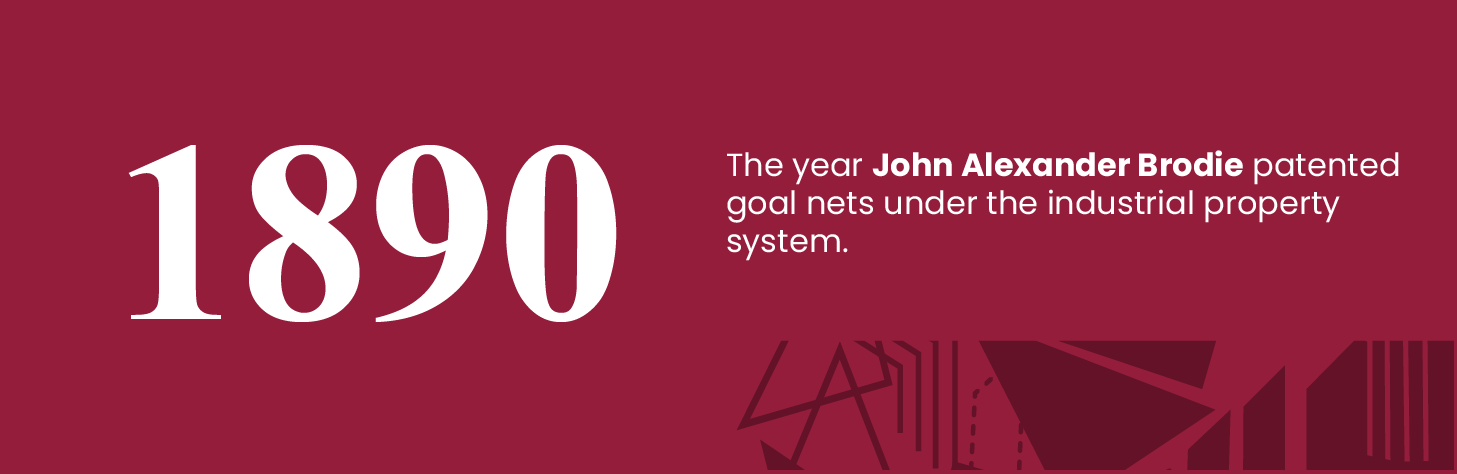
In 1889, in a match between Everton and Accrington in Liverpool, a ball crossed -or didn't cross- the goal line, and no one could prove it. Among the audience was John Alexander Brodie, a civil engineer and Everton fan, tired of arguments that no human eye could resolve. His solution was almost ridiculously simple: a net behind the posts. He patented it in 1890 under the name "goal nets for soccer and other games." Without knowing it, Brodie had just inscribed one of the first pieces of industrial property of modern football. Since then, every goal celebrated by the world is literally trapped within a registered invention.
If a rope net could have an owner, imagine what awaited a gold trophy.
The trophy that's worth more dead than alive
FIFA commissioned the French sculptor Abel Lafleur to create a golden statuette of Nike, the Greek goddess of victory, to crown the first world champion in 1930. Renamed the Jules Rimet Cup, the piece lived through more intrigue than any soap opera: stolen in London in 1966 and recovered by chance thanks to a dog named Pickles who sniffed it under a bush; given in permanent ownership to Brazil after their third title in Mexico 1970; stolen again in 1983 in Rio de Janeiro, this time forever, allegedly melted into gold bars. Since then, since 1974, the trophy that is raised today, designed by the Italian sculptor Silvio Gazzaniga, never physically leaves FIFA's hands: champions receive a replica, and the original is secured with the same logic used to protect any valuable asset today.
And it is not a legal metaphor, it is the document's text itself, as FIFA's own Intellectual Property Guidelines list the "official trophy" among their protected brand assets, alongside the logo, mascot, and tournament slogan.
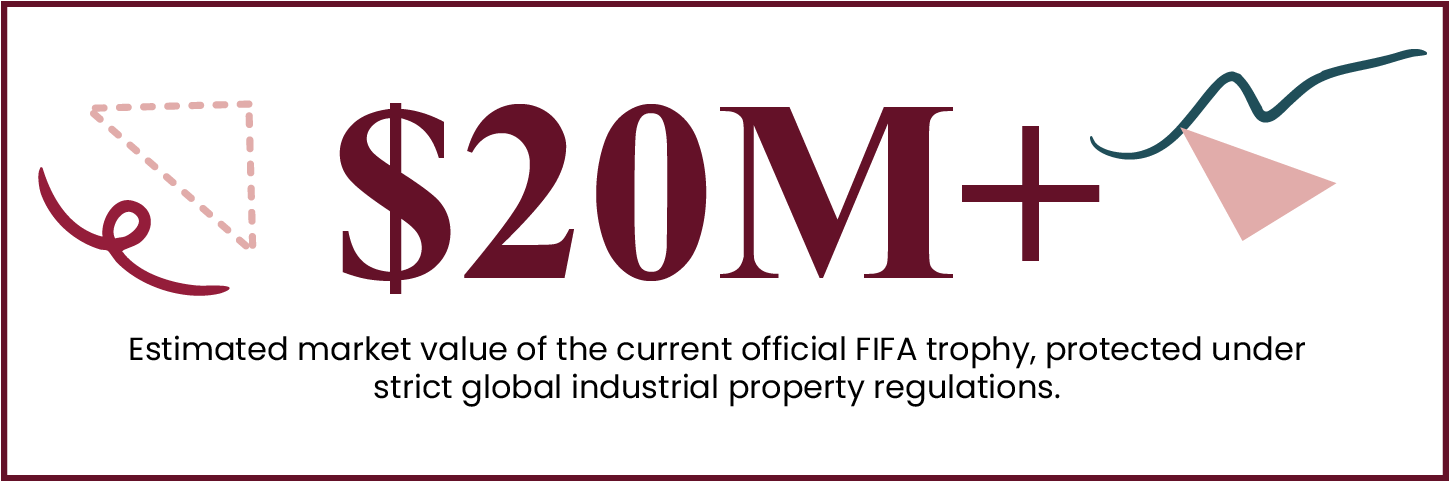
Its symbolic and commercial value exceeds 20 million dollars, and its contact protocol is stricter than that of any museum piece: only world champion footballers and coaches, heads of state, and senior FIFA officials can touch it. Replicas are, in fact, one of the products most pursued by the organization's anti-counterfeiting program. The lesson of the Jules Rimet is not that a trophy was lost. It’s that a symbol, unlike gold, cannot be melted, but it can be registered, licensed, and pursued in courts.
From the trophy, we go down literally to the feet.
The foot also signs contracts
Germany won its first World Cup in 1954, in the famous "final of Bern," with a detail that the press barely noticed: they wore boots with interchangeable studs, which a shoemaker named Adi Dassler -founder of Adidas- adjusted depending on whether the field was wet or dry. He didn't invent the original idea (the German Patent Office registers a parallel application from 1949 in the name of Alexander Salot), but it was Adidas who turned it into a sports legend. Lesson number one of intellectual property: it's not always the one who invents who wins, but the one who knows how to protect and tell the story.
Sixteen years later, in Mexico 1970, soccer learned that boots could also act. Before a quarterfinal match, Pelé asked the referee for a few seconds to tie his laces. It wasn't a coincidence: Puma paid him $120,000.00 for that gesture, and even coordinated with the camera crew to ensure the close-up, after their archrival Adidas thought it had shielded the Brazilian star with a non-aggression pact between the two brands, according to the most repeated version of sports marketing.

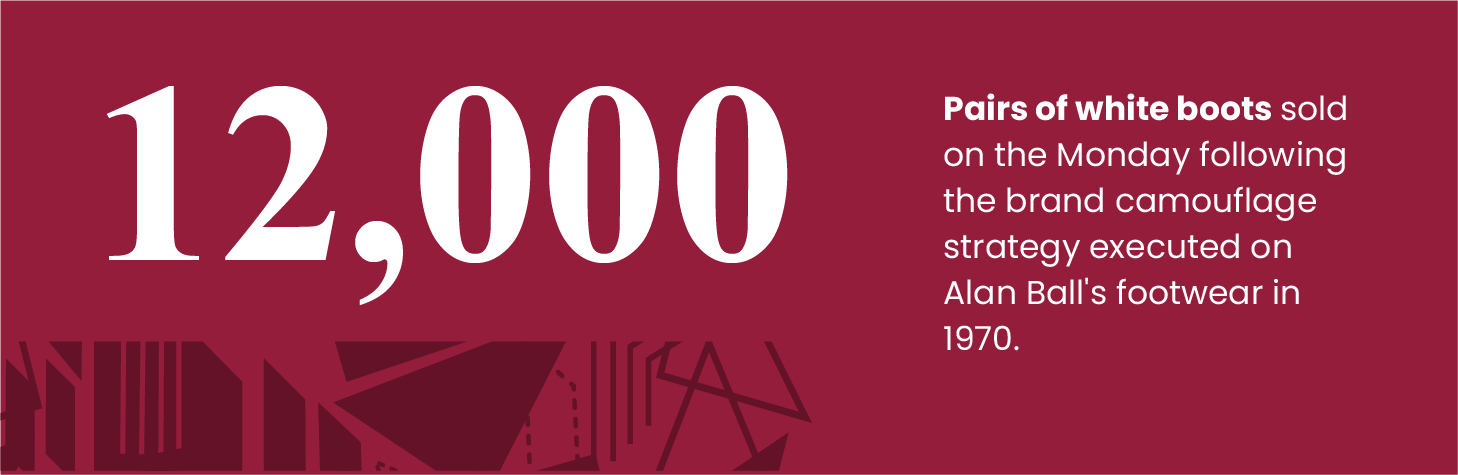
That same year, in England, the Danish brand Hummel didn't have time to manufacture boots to measure for the Englishman Alan Ball, world champion with England in 1966 and an Everton figure, so they painted a common pair of Adidas white, hiding the three Adidas stripes, so they appeared to be Hummel on camera. One of the first major visual coups of white boots in televised professional soccer; the following Monday, twelve thousand pairs were sold. 1970 was marked as the year when boots began to speak as loudly as the match results.
Twenty-four years later, the lesson was repeated almost identically, this time with a patent in between. Craig Johnston, a former Australian player for Liverpool, had the idea to stick table tennis racket rubber onto a boot to improve grip with the ball while coaching children in Sydney. Adidas, Nike, and Puma rejected it until Adidas reflected and bought the rights in 1994, and the "Predator" was born. It became one of the most recognized and profitable lines of boots (soccer cleats) in history. The brand kept the asset and the inventor, with the anecdote.
That's why in intellectual property, there is so much insistence on organizing ownership from the beginning. A creation can start as an experiment, a detail, or an occurrence; but if it works, tomorrow it can be a brand's most valuable asset.
From footwear, we go up to the face.
When the footballer himself became a brand
Image rights in soccer didn't start with Cantona, Beckham, or Ronaldo Nazário. They started, at least formally, in an uncomfortable conflict during the 1974 World Cup in Germany. Johan Cruyff, a Dutchman, had a personal contract with Puma, while the Netherlands national team wore Adidas. When the federation negotiated with Adidas and refused to share with him what they earned from that agreement, Cruyff did not refuse to play: he asked to have one of the three stripes removed from his jersey. He played all seven tournament games with a two-striped jersey, the only one like it in the entire team. "They denied me my share saying the jersey was theirs, and I told them the head was mine," he explained years later. It was essentially the first public standoff between a footballer's image rights and the commercial commitments of the team they represented, almost fifty years before any current sports lawyer had to resolve that same conflict in a contract.
Two decades later, that tension became an industry. Eric Cantona, with his rebellious personality, even turned the raised collar of his jersey into part of his character, and thus became the voice of Nike Football. In "Good vs Evil" (1996), it was he who scored the decisive goal, a shot that pierced the devil himself while murmuring a laconic "au revoir." The brand wasn't just selling clothing. It was selling personality. David Beckham turned his name, and his right leg, the one responsible for all his free-kick goals, into an asset as valuable as his own talent. Ronaldo Nazário, the "Phenomenon," was selling something no factory could mass-produce: a way of dribbling that seemed impossible.

There, the right to image ceased to be a locker room anecdote like Cruyff's and turned into an entire industry: the footballer stopped being just a worker under contract with his club and became a platform of personal assets, capable of generating royalties separate from his team, his national team, and even the tournament he played in.
Someone had to organize all that talent into a business. That someone was Brazilian.
The president who turned the World Cup into a commercial platform
Coincidentally, the same year Cruyff was having his showdown with Adidas, João Havelange took over the presidency of FIFA and found an organization still small, with a handful of employees. Together with Horst Dassler, the son of Adidas' founder, and advertiser Patrick Nally, they designed something no one had tried on that scale: to buy in block the World Cup's commercial rights and resell them, in parts, to global brands in exchange for total exclusivity. It took them over eighteen months of persistence, but when Coca Cola pledged a large sum to become the first exclusive worldwide sponsor in sports history, football ceased to be just a game. It became an industry of brands, licenses, and contracts that we still inhabit today.
Mexico 1970, the same World Cup as Pelé's anecdote, and the first that consolidated football as a global color television spectacle, did the rest: it turned every second of broadcast into an intangible asset with its own price. And where there's a price, sooner or later, there's a good dispute.
The showdown that wasn't played on the field
The nineties took that dispute to another level. Coca Cola, FIFA's historical ally since Havelange's time, defended its position as the official sponsor; Pepsi, without being an official sponsor of the tournament, signed the stars of the moment: Beckham, Roberto Carlos, Ronaldinho, Raúl González, and Francesco Totti, for commercials that are now part of football's advertising memory, like the old west duel between Real Madrid and Manchester United or the "Surf" ad, filmed among the waves of Fiji. Adidas held an official spot within FIFA's ecosystem; Nike, without occupying that official sponsor program place, built its own parallel universe with cinematic campaigns like the aforementioned "Good vs Evil" (1996) and the memorable 1998 airport commercial directed by John Woo, which helped make the Brazilian team one of the most recognizable faces of the "Swoosh" in the universe.
Behind those campaigns, there was a less visible but equally important dispute: that of trademark registrations, exclusivity contracts, and regulations that were starting to draw a still blurry line between legitimate advertising creativity and what we now call "ambush marketing": the trick of associating with a major event without paying a cent for the right to do so.
That line, thirty years later, remains the favorite sport of the planet's smartest brands. And this World Cup proved it once again.
The absence that became the best free commercial
FIFA strictly enforced its "clean stadium" policy in the 2026 World Cup: all non-sponsor brands had to cover themselves within stadiums, even those whose naming rights contract gave the venue its name. When it was Levi's Stadium in Santa Clara's turn, the brand covered its logo with a white tarp that still hinted at its silhouette.
Gillette responded at its Massachusetts stadium with the visual idea of covering its own name with shaving foam.
Even food fell victim to the same rule. In the VIP and press areas of the stadiums, FIFA employees covered Heinz sauce bottles with black tape, container by container, as Heinz is not an official sponsor, including a piece of tape over a Tabasco sauce. Heinz responded on social media with a photo of its own censored bottles and the message: "You can cover the name, but the taste gives us away," and both brands used a conversation between them as advertising.
Technically, FIFA won: no logo remained visible on camera. But without paying a dollar of official sponsorship, these brands gained media coverage they would scarcely have achieved with traditional advertising. In the digital era, even absence communicates.
That same lesson was repeated outside the stadiums, in Germany.
The brand that became national identity: when breaking a contract hurts like losing a final
That same tension between exclusivity, visibility, and brand memory appears outside the stadiums too. Because if World Cup rules can force a logo to be covered for a few weeks, a sponsorship contract can erase a story from a jersey that's been built over a long time.
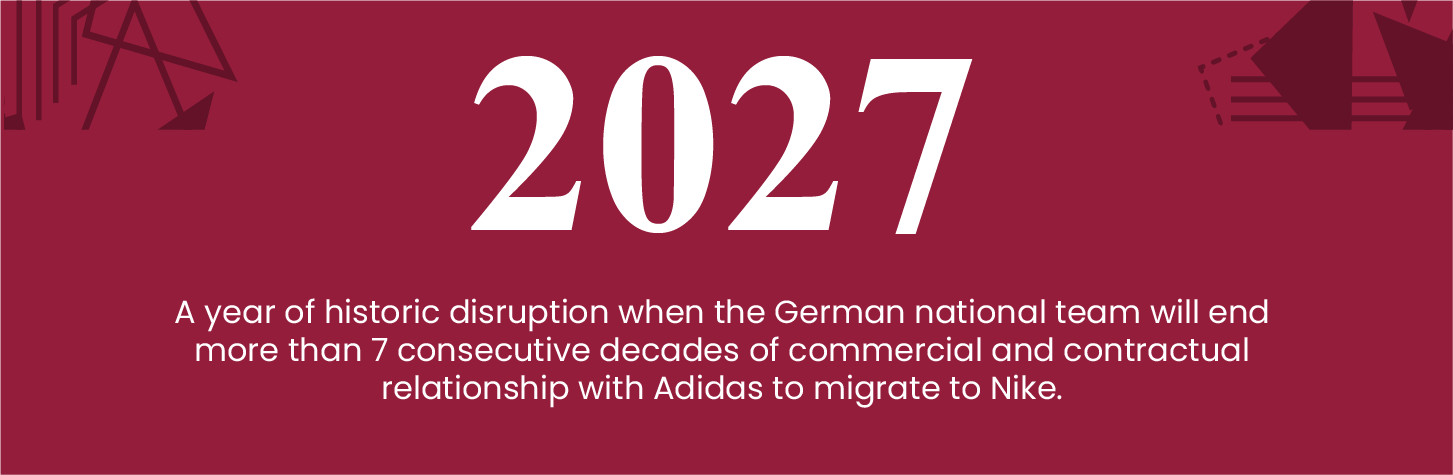
After more than seventy years dressing the German national team since 1954 - the one with the interchangeable studs - Adidas will lose that sponsorship starting in 2027 when Nike takes over the technical contract for a sum that, according to international media, would double what's been paid so far. The news generated political and emotional reactions in Germany: high-ranking officials described Adidas' departure as losing part of the national football identity. The episode confirms what we repeatedly tell our clients: a brand well associated with a team is not a logo; it's a legal and emotional construction that takes generations to build and only one bidding cycle to crumble.
And while brands fight for the jersey, the ball itself began to generate intellectual property even Brodie couldn't have imagined.
The football that is also licensed
The 2026 World Cup has shown that its value also lies in the data each play produces. Connected ball, semi-automated offside, and artificial intelligence refereeing generate valuable information, and thus new questions arise: who owns the software, who licenses the sensors, who controls the performance databases, and how far can that information be reused; modern football is also measured, processed, and licensed.
And to close the circle, let's return to the feet.
Color as a brand asset: the fashion that dressed the 2026 World Cup
Fifty-six years after that play by Hummel with Alan Ball's white boots for him to shine on camera, Nike, Adidas, Puma, and New Balance each ultimately bet, from their own strategy, on the same family of tones: entire collections in 'Electric Fuchsia.' It was no coincidence. WGSN, a global consultancy that anticipates fashion, consumer, and color trends, had already identified that tone as one of the visual bets of the season; and the Pantone Color Institute, a division of Pantone dedicated to color trend analysis and forecasting, helps to understand why color is also designed with commercial intent, precisely because it creates the most aggressive contrast possible against the green of the field, ideal for cell phone screens and slow-motion replays. The result: a literally pink World Cup. The aesthetic is a marketing decision as calculated as any trademark registration, only that instead of lawyers, it is signed by trend designers, then brands turn it into desire, but Intellectual Property should arrive from the beginning, before what seemed like just a color, an idea, or a simple detail ends up becoming an asset.
The final score
From the ingenuity of a fan of Everton to fuchsia boots programmed by a trend algorithm, there are one hundred thirty-six years of history, but a single guiding thread: football generates value, and all value needs an owner, a contract, and a legal boundary that protects it. For entrepreneurs, federation members, directors, the footballers themselves, and those who live it, understanding that invisible architecture (patents, trademarks, image rights, broadcasting rights, and the rules of commercial shielding) is no longer a technical luxury reserved for lawyers.
Those negotiating today the signing of a player, the venue of a stadium, or the sponsorship of a federation are, knowingly or not, negotiating intellectual property. The next big chapter of this century-old story will not be written on the field but at the table where those contracts are signed. And there, as in any final worth its salt, it's wise to arrive well-advised.
Maybe that's why this article makes so much sense. Football has allowed us to see intellectual property in motion, not as an independent subject of records and contracts, but as the way an idea, when well cared for, can become memory, business, and identity and continue to grow without losing its owner or proprietor.
These lines were born between football memory and the obsession to find intellectual property in places where almost no one is looking.
Next articles in this category

September 2026
Reforms to the Law for the Promotion of Investment Expansion
The Legislative Assembly approved the reform to the Law for the Promotion of Investment Expansion on September 9, 2026. The reforms will enter into force eight days after their publication in the Official Gazette. The amendments broaden access to the regime by reducing the minimum operating history requirement, allowing participation by corporate groups, easing exclusion rules, and introducing a new methodology for calculating the tax credit.

September 2026
New Professional Liability Rules For Urban Development And Construction
El Salvador has enacted a new Special Law on Professional Liability regulating the planning, design, execution, supervision, control, and maintenance of urban development and construction projects. The law applies to natural and legal persons subject to registration in the Registry of Professionals and Service Providers for Urban Development and Construction. It entered into force on September 19, 2026, as communicated by the Directorate of Territorial Planning and Construction (DOT) on September 21, 2026. As of the date of this publication, the law is not yet available for consultation on the Official Gazette’s website.

August 2026
CNAD Circular No. 008-2026: New Data Protection Compliance Requirements
The National Commission of Digital Assets (CNAD) issued Circular No. 008-2026, addressed to Digital Asset Service Providers and Certifiers, through which it communicates the Guidelines for Personal Data Protection Delegates issued by the State Cybersecurity Agency (ACE).

August 2026
Personal Data Protection Law in El Salvador: Everything You Need to Know About the CNAD’s New Provisions
Digital Asset Service Providers and Certifiers overseen by the National Digital Assets Commission (CNAD) must review the designation, profile, and registration of their Personal Data Protection Delegate, as well as establish an institutional communication channel with the State Cybersecurity Agency (ACE), in accordance with the new personal data protection provisions in El Salvador.